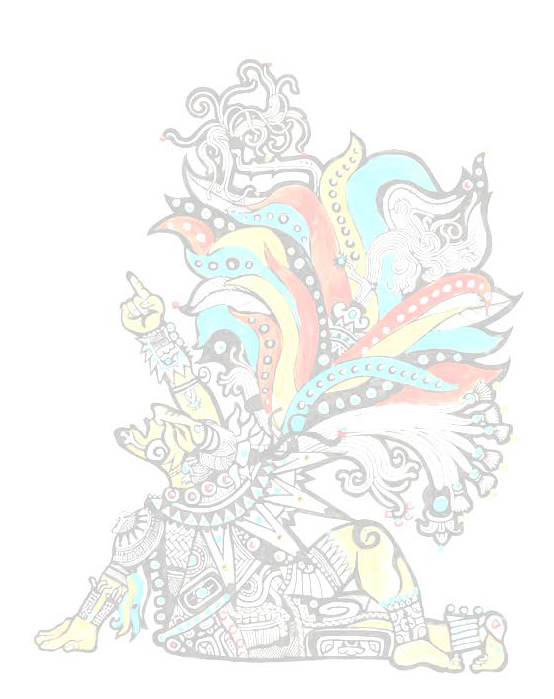
Keepers of Time
By Marco Pacheco
One of the most important accomplishments and contributions of our Maya ancestors for all humanity past and present—is their calendars. The ancient Maya were astronomers and mathematicians who created a suite of calendars for different uses. Their careful observations and understanding of the motions of stars and planets around the sky gave them an ability to create different calendars. There are at least 20 known Maya calendars, each with different purposes. Among them are two calendars that are still used today by Maya communities and worldwide by those who have adapted them to their daily lives. These two calendars are the Haab (Cholq’ab), a solar or secular calendar, and the Tzolk’in (or Cholq’ij), a lunar or sacred calendar. These calendars represent the dual nature of human beings. The Haab is the masculine energy, and the Tzolk’in is the feminine energy. For Mesoamerican communities, duality is necessary for balance and harmony.
The Haab is made up of 365 days, like the Gregorian calendar used throughout the world today. The Haab measures time in 18 named months (Winales), each with 20 numbered days, plus 1 month of 5 days (Wayeb). The Tzolk’in is made up of 260 days that come about from the permutation of the numbers 1 -13 with 20 named days. Any specific day will have a date within both the Tzolk’in and Haab calendars. Both calendars are cyclical or circular. These calendars can be visualized as two gears that cycle in opposite directions. A date formed by the combined calendars will only repeat every 52 Haab years.
The Gregorian calendar is a solar calendar designed to keep the date of the spring equinox on or near March 21st. The calendar designers wanted an important solar alignment (the equinox) to fall on the same calendar date each year. To do that, they occasionally added a day to the calendar (leap years). However, the Maya prefer the orderly rhythm of constantly repeating cycles. So, in the Haab calendar, the date of the spring equinox changes over time. After 52 Haabs, the spring equinox occurs 13 days earlier.
The true length of the solar year was known by the ancient Maya to very high accuracy. Inscriptions on a monument at Copán indicate that they had calculated the length of the solar year to be 365.2420 days, which differs from the modern value of 365.2422 days by only 17 seconds. Such great accuracy indicates careful observations and record-keeping spanning many generations.
The Tzolk’in calendar has had the biggest influence on all indigenous Mesoamerican cultures and is now being used worldwide. Before the Spanish Conquest, all of Mesoamerica lived in perfect spiritual synchronization using the Tzolk’in calendar. The Tzolk’in is used to calculate agricultural working seasons and to set dates for religious ceremonies. This calendar also has two main functions: for collective and individual activities. The Tzolk’in is a calendar based on the motions of the Moon. But why the Moon? The cycle of the Moon’s phases is 29.53 days as it orbits around Earth. In nine cycles of the Moon’s phases, just over 265 days pass. This is also the average gestation period for a human (nine months). A common tradition in Mesoamerica is to name a child after the day of the Tzolk’in on which they are born, because that day is also approximately when they are conceived. Another correlation between the Tzolk’in and humans is through their 20 fingers and toes and 13 body articulations (ankles, knees, hips, shoulders, elbows, wrists, and neck). There is also a connection to our sacred food, corn. The corn growing season is 3 months, so the combined corn and human “growing season” is 1 year.
The Tzolk’in calendar also relates to other astronomical cycles. For example, two Tzolk’in cycles (520 days) are equal to three eclipse seasons (there are about 173 days between times when lunar and solar eclipses are possible). Also, three Tzolk’in cycles (780 days) are equal to one of Mars’ synodic cycles (cycle of Mars’ location in the sky relative to the Sun from Earth’s perspective, i.e., from conjunction to conjunction or opposition to opposition).
The Maya composed the Haab and the Tzolk’in to have sense and purpose. The numbers, colors, energies of the day, the month they govern, the year’s bearer and the phase of the Moon guide our lives, so that we may live more completely. For the Maya, nothing is a coincidence. Everything has a purpose. With this concept, the ancient Maya gave us these calendars and their daily use to respect and connect with the sky (Heart of the Sky) and nature (Heart of Mother Earth). This gives us the ability to live in perfect harmony and understand that everything and all of us are one heart beating to the cosmic rhythm.
It’s true that the Maya calendars measure time, but their functions go beyond that. For example, the Maya calendar helps us understand how we, as humans, relate to the surrounding cosmos and nature. These calendars give us a chance to understand our essence and our role as human beings, and to live in harmony and balance with our spirituality and everything that surrounds us. The calendars, especially the Tzolk’in, allow us to live in unity and harmony with all people, even those who speak different languages or come from different cultures. The calendars give us a chance to understand our feelings and ideas, and to live in complete peace and harmony with everyone and ourselves.